By Abigail Wilkinson, Charlotte Bell, Dion Reid, and Victoria Barnard
[This summer, the Family Archives project was joined by four 1st and 2nd year undergraduate students as part of the University of Birmingham’s Research Internship scheme. Together, they have been working on the family books compiled by eighteenth-century gentlewoman Lady Sarah Cowper. They gave a paper on their research at the recent ‘Family Archives & their Afterlives’ Conference (27 & 28 June 2023): the report below summarises their initial findings and experiences…].
Sarah Cowper (1707-1758) was the daughter of William, 1st Earl Cowper and Mary Clavering, Countess Cowper, as well as the granddaughter of famed diarist Dame Sarah Cowper. In comparison with her more famous forebears we know relatively little known about ‘our’ Sarah’s life. She died unmarried and childless, and her ‘family books’ appear to be the most significant thing left behind after her death. Comprising of 8 volumes and spanning the years 1692 to 1737, these books are a compilation of the letters, diaries, and assorted other writings penned or preserved by her ancestors, partially and selectively transcribed and arranged in chronological order. Sarah inherited these family papers after the death of both her parents in the winter of 1723/4, but we aren’t entirely sure when Sarah produced the books. Based on the way some people are referred to, and which dates are included, we believe she started her project sometime in the 1740s.

[Pages from Volume 6 of the Family Books. Reproduced by kind permission of Hertfordshire Record Office].
Volumes 1 and 2 are made up of correspondence between Sarah’s mother, Queen Anne and the Duchess of Marlborough. The first part of book 2 covers the intertwining political and social tensions amongst members of Queen Anne’s Court from 1706 up until her death in 1714. The second half of book 2 is based on Dr David Hamilton’s memoirs, who was Physician to the Queen: through these entries Sarah frames the final years of the Queen’s life. The events in Volumes 1 and 2 took place during Sarah’s youth and represent an effort to frame her father and mother in a favourable light, both politically and personally.
The third book in the collection spans the tumultuous years 1714 to 1716 which are played out in the letters, diary entries and political speeches filling the volume’s pages. While working through the book, Lady Mary Cowper’s (Sarah’s mother) influence over the circles within the court and the political landscape was striking. Alongside her close relationships with figures such as the Duchess of Marlborough and the Princess of Wales, Mary’s fluency in French placed her in a position of power as she translated messages and treatises from her husband to the King. The focus on Mary’s papers makes this volume very similar to the first two Cowper books, suggesting that much of the family papers were preserved by Mary herself. The process of organising, transcribing and formatting her family papers was one that Sarah perhaps felt a duty to undertake after inheriting years of national and family history, yet while working through the volume we came to understand the sheer investment involved in Sarah’s project, and the time it would have taken to preserve these periods in her family history.
Book five spans from 1718 to 1720 and mostly consists of letters written to Lord and Lady Cowper by various members of the aristocracy, as well as drafts of their letters. Many of the letters in the book’s first part highlight the nobility’s response to Lord Cowper’s resignation of the Royal Seal and his position of Lord High Chancellor. Also, a significant number of letters comment on the estrangement between the Prince of Wales and King George I, and how Lord and Lady Cowper tried to reconcile them due to the quarrel negatively affecting English politics in a time of crisis. As well as including letters of political significance, Sarah Cowper includes letters about significant family events, such as when her family was ill with scarlet fever. Sarah also increasingly includes personal comments on the events which are taking place within the letters, such as describing how her parents took turns watching over her at night when she was ill as they were fearful she may die. Furthermore, Sarah includes information on historical events which were occurring during 1718 to 1720 in between the transcribed documents, such as the eruption of La Soufrière in 1718. This suggests that she expected the book to be read by future generations who would not have knowledge of these events, and to also provide the documents included within the book context, making the events and issues recounted more understandable.
Book six spans the years 1721-1729. It consists mostly of letters from William to Mary prior to their deaths, along with some political acts and events. Throughout this volume Sarah’s own comments increase as she would have been old enough to remember what she was doing at the time, such as attending balls and writing articles with her cousins. Furthermore, when she writes about her parent’s period of illness and their deaths, entire pages are taken up by her personal account of the events, paired with letters from family members and other powerful families. Partially because of this the books generally increase in length, with book one being approximately 170 pages, while book six is 370, this may also be because she became more passionate about the project or had a clearer idea of how to best tell the narrative. It was interesting to read Sarah’s comments as they increased through the book as it felt like it gave a sense of who she was based on what verses she picked, and which stories she chose to tell. This was especially noticeable since the books (although by her) are barely about her, therefore it was enjoyable seeing the small pieces of her own life preserved in the letters of others, and makes you wonder why she chose each thing she did. It also felt like you could see her opinion on a person based on what she chose to include about them.

[Panshanger House as depicted in Francis Orpen Morris, The County Seats of the Noblemen and Gentlemen of Great Britain and Ireland, vol 1 (1866).
It seems likely that Sarah Cowper’s Family books would have been stored in her family’s country home at Panshanger, Hertfordshire, and the books are now in the Hertfordshire Archives. We considered whether the volumes themselves were meant to have a social life as an archive. On this note, the Marlboroughs, who were close family friends and politically aligned to the Cowpers, exemplify this possible public intent. Sarah includes personal letters and ‘proof’ of accounts in defence of the Duchess of Marlborough after 1711- when she fell out of favour in court. In this way, these empirical accounts could be seen as a form of Sarah practising public family history. We are also working with the assumption that much of her reasoning for compiling these books was to paint her family (in particular her father) in a positive light, after several political scandals discredited the family name. This is apparent through Sarah’s inclusion of many letters praising her father’s political skill and loyalty, whilst leaving out some of the more scandalous aspects of his life. Furthermore, we found it interesting that a large portion of the letters are ‘extracts from’ rather than the letters in full which shows she is consciously creating a narrative, but we are not sure what sections have been missed out. Many of the transcribed documents still exist and an aim for the future is to compare the content to get a better idea of what Sarah viewed as unimportant.
Overall it was fascinating to work with these manuscript materials, as we had very little knowledge of the time period beforehand, and now feel like we have concluded our research project with a fascinating knowledge base through the lens of a woman in the 1700s. It was especially interesting to acquire this knowledge literally from her own hand, as we read pages of family history while deciphering eighteenth-century handwriting. It felt especially surreal knowing we were highlighting the voice of a woman who slipped through the cracks of history.
[Thanks to Victoria, Dion, Abigail, and Charlotte we now have a complete inventory of the items transcribed in the family books. I’m currently working on an article on these volumes, so watch this space].
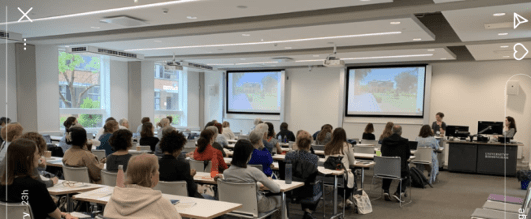
[Delegates at the ‘Family Archives & their Afterlives’ Conference, where the Research Intern team delivered a paper].
 Family Archives and their afterlives in England, 1650-1838
Leave a comment